
Solving the NBA’s Tanking Problem
Goodhart’s Law and the “Smell Test”

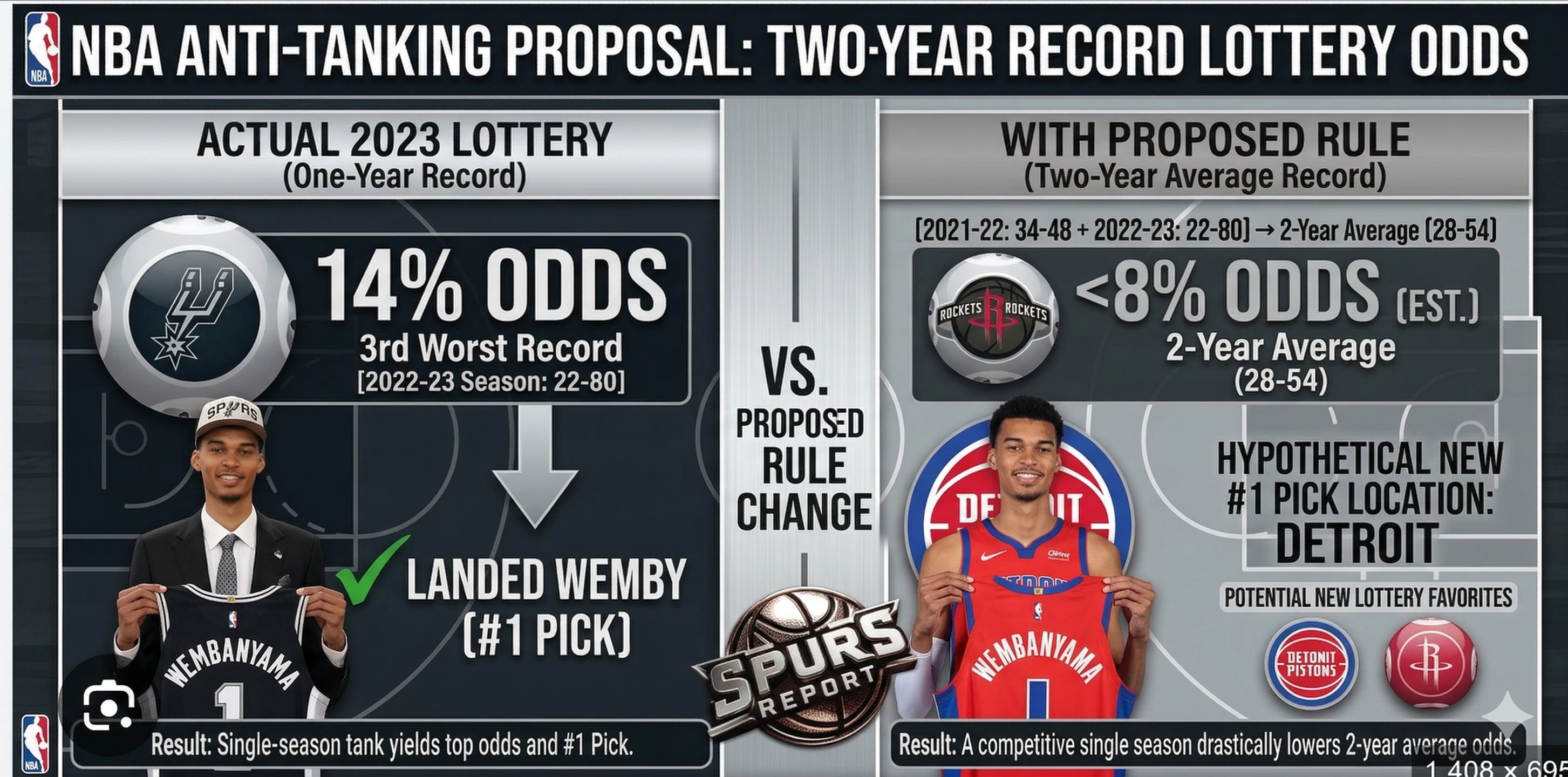
The NBA announced this week that it’s trying—for the fourth or fifth time—to fix tanking by redesigning its incentive structure. I can tell you, before reading a single proposal, that all three plans will fail. A 50-year-old economic principle explains why—and it points to a very different kind of solution.
Commissioner Adam Silver presented three anti-tanking proposals to the board of governors and promised that the incentive structure will change next season. “We are going to fix it. Full stop.” I don’t doubt his sincerity. But the NBA has done this before—multiple times, going back decades—and it has failed every time. It will fail again, and for the same reason it always fails. The league keeps trying to solve a problem that can’t be solved with rules. What it needs instead is a smell test.
Goodhart’s Law
In the 1970s, British economist Charles Goodhart observed something that should be tattooed on the wall of the NBA’s league office: “When a measure becomes a target, it ceases to be a good measure.” The idea is simple. The moment you tie a reward to a specific metric, people stop trying to achieve the thing the metric was supposed to capture and start optimizing the metric itself. Teachers teach to the test. Wells Fargo employees opened millions of fake accounts to hit sales targets. The measure gets gamed because the measure is all that matters.
This is exactly what happens every time the NBA reforms its draft lottery. The three new proposals are creative—they restructure the incentives so that losing confers less advantage. Flatten the odds. Expand the pool. Average across seasons. But each one is just a new measure, and Goodhart’s Law tells you what will happen next: teams will optimize around whatever the new measure is. When the NBA flattened the lottery odds in 2019, teams stopped racing to be the absolute worst—and instead, more teams found it rational to tank, since the difference between the 4th-worst and 8th-worst record shrank to a couple of percentage points. The league didn’t eliminate tanking. It redistributed it.
Average across two seasons? Now a team that was decent last year has more reason to bottom out this year to bring down the two-year number. Add play-in teams to the lottery? Now a fringe playoff team has to weigh whether a first-round exit is worth more than a small lottery shot. Every structural fix contains the seeds of its own new distortion. Squeeze the balloon in one place and it bulges somewhere else.
The Smell Test
Here’s what’s strange: we don’t actually need new rules to identify who’s tanking, because it’s already obvious. The Ringer published a piece ranking the eight most shameless tankers this season. The Jazz were fined $500,000 for sitting healthy starters in competitive games. The Players Association publicly called out ownership. Every writer, fan, and broadcaster covering the league can name the offenders. Tanking isn’t hard to identify. It’s hard to formalize—and the NBA keeps confusing those two things.
In 1964, Justice Potter Stewart faced the same problem. The Supreme Court was trying to define obscenity—to draw a precise legal line—and every formal test produced absurd edge cases. Stewart gave up and wrote one of the most famous lines in legal history: “I know it when I see it.”
The NBA should take his lead. Stop searching for the perfect formula. Create an independent evaluation committee—veteran journalists, former players and coaches, competitive integrity experts—whose job is to evaluate every non-playoff team and assign a tanking score based on whether it passes the smell test. Did they trade away their best players for future assets? Are healthy starters mysteriously sitting out? Are the lineups designed to lose close games? No single factor is proof. The committee is looking for a pattern, the same way every basketball writer already looks for it, all season long.
Reasonable rebuilding wouldn’t trigger this. A committee of basketball lifers can distinguish between a team that traded an aging star at a player’s request and a team that dumped three starters in January to crater its record. That’s judgment, not guesswork.
Teams with higher tanking scores would face real consequences: reduced lottery odds, or for the most egregious cases, exclusion from the top tier of the draft altogether. The specifics can be worked out. The principle is what matters: if you look like you’re tanking, you get penalized, and the penalty is severe enough to make tanking a genuinely bad strategy.
Why This Scares People
The objection writes itself: that’s subjective. It is. But that’s exactly why it works. With a formal rule, teams know exactly where the line is, and they can creep right up to it. That’s Goodhart’s Law in action—once you know the measure, you optimize around it. But with a committee making holistic judgments, there is no bright line to exploit. Teams won’t know precisely what combination of moves will trigger a penalty. So they’d better not do anything that looks like tanking. They’d better look like they’re trying to win—in their trades, their lineups, their injury reports, their fourth-quarter rotations—because anything that smells wrong could cost them. The uncertainty itself is the deterrent.
Think of it this way. A speed limit is a formal rule: everyone knows it’s 65, so everyone drives 70. But an unmarked police car on the highway? No one knows where it is. No one knows exactly what will get them pulled over. So everyone slows down. The NBA doesn’t need a better speed limit. It needs an unmarked car.